
Understanding the exact EV charging franchise cost in India is the vital first step for entrepreneurs looking to enter the booming electric vehicle market. As the country shifts rapidly toward sustainable transportation, the demand for accessible and reliable EV charging infrastructure has skyrocketed. This green revolution is backed by strong government initiatives, increasing consumer awareness, and a massive influx of new electric car and two-wheeler models hitting the Indian roads every month. However, for a business owner, building a station from scratch can be daunting, which is why partnering with an established brand through a franchise model has become the preferred route. A franchise offers technical support, brand recognition, and a ready-to-use software ecosystem, significantly mitigating the risks associated with a new business venture. In this comprehensive guide, we will break down the exact costs involved, the best franchise models available, the space requirements, and the projected return on investment (ROI) to help you make an informed decision about launching your own EV charging station in India.
- The Growing EV Infrastructure and Franchise Opportunities in India
- Why Choose a Franchise Model?
- Understanding Different Operating Models
- Detailed Breakdown of the EV Charging Franchise Cost in India
- Land, Civil Work, and Infrastructure
- Hardware and Electrical Upgrades
- Top Brands Offering EV Charging Franchises in India
- Evaluating Franchise Support Systems
- The Importance of App Interoperability
- Analyzing the Profitability and ROI of Your EV Franchise
- Calculating the Break-Even Point
- Government Policies Impacting Profitability
- Conclusion
The Growing EV Infrastructure and Franchise Opportunities in India
India’s electric vehicle sector is witnessing exponential growth, transforming the automotive landscape and creating lucrative opportunities for infrastructure development. The Indian government has set an ambitious target to achieve 30% EV penetration for private cars, 70% for commercial vehicles, and 80% for two and three-wheelers by 2030. To support this massive fleet, millions of charging stations will be required across highways, urban centers, malls, and residential complexes. Franchising has emerged as the most scalable way to bridge this infrastructure gap. By opting for a franchise, investors bypass the steep learning curve of hardware procurement, grid compliance, and software management. The parent company handles the backend complexities, such as the Central Management System (CMS), mobile app integration, and round-the-clock customer support. This allows the franchise owner to focus on local operations, site maintenance, and customer acquisition. Depending on the investor’s capital and involvement, various franchise models have been developed to suit different business needs.
Types of EV Charging Franchise Models in India
| Franchise Model | Investment Level | Best Suited For |
|---|---|---|
| COCO (Company Owned Company Operated) | High (Corporate level) | Large scale corporate investors and parent brands |
| FOFO (Franchise Owned Franchise Operated) | Medium-High | Active entrepreneurs wanting maximum profit control |
| FOCO (Franchise Owned Company Operated) | Medium | Passive investors and commercial property owners |
| Destination Charging (Hotels/Malls) | Low-Medium | Business owners wanting to attract EV drivers |
| Highway Charging Hubs | Very High | Consortiums, fuel pump owners, highway developers |
| Fleet Charging Hubs | High | Logistics partners and taxi fleet operators |
Why Choose a Franchise Model?
Starting an independent EV charging station involves sourcing compliant chargers, building an app, integrating payment gateways, and securing complex grid approvals. A franchise eliminates these hurdles. You gain instant access to a trusted brand name, standardized equipment that complies with local regulations, and a unified app network that EV drivers already use to locate chargers. This networked visibility is crucial for driving traffic to your station.
Understanding Different Operating Models
Before looking at the numbers, it is essential to understand the operational structures. The most common models are FOFO (Franchise Owned Franchise Operated) and FOCO (Franchise Owned Company Operated). In a FOFO model, you invest in the infrastructure and run the daily operations, retaining a larger share of the profits. In a FOCO model, you simply provide the capital and the location, while the brand handles operations, offering you a fixed percentage of the revenue. Your choice directly impacts the initial EV charging franchise cost in India and your long-term returns.
Important Market Insight
Government Push and Subsidies
The FAME II (Faster Adoption and Manufacturing of Hybrid and Electric Vehicles) scheme and various state-level policies offer significant capital subsidies for installing public EV charging infrastructure, which can drastically reduce your initial out-of-pocket franchise cost.
Detailed Breakdown of the EV Charging Franchise Cost in India
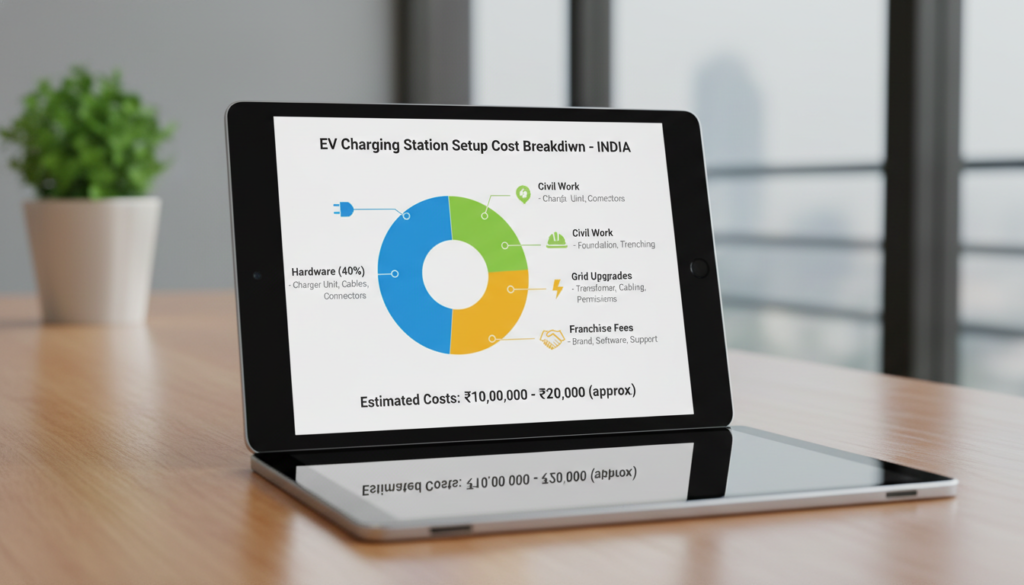
When calculating the EV charging franchise cost in India, investors must look beyond the price of the charger itself. A commercial charging setup involves multiple layers of expenditure, including land acquisition or leasing, civil engineering, electrical grid upgrades, hardware procurement, and software licensing. A basic setup with AC slow chargers for two and three-wheelers can start as low as ₹2 Lakhs to ₹5 Lakhs. However, a fully equipped commercial fast-charging station (DC fast chargers) for four-wheelers will require an investment ranging from ₹15 Lakhs to ₹40 Lakhs or more. The franchise fee itself varies by brand. Some brands waive the upfront franchise fee to encourage expansion, instead taking a larger cut of the ongoing software and transaction revenue. The bulk of your capital will go toward purchasing the chargers and upgrading the local electrical infrastructure. High-capacity DC fast chargers draw immense power, often requiring a dedicated distribution transformer, separate HT/LT cables, and safety switchgears, which can add significantly to the civil and electrical costs.
Estimated Cost Breakdown for a Standard Commercial EV Station (in INR)
| Cost Component | Estimated Minimum Cost | Estimated Maximum Cost |
|---|---|---|
| Franchise Fee / Security Deposit | ₹0 (Some brands) | ₹5,00,000 |
| EV Chargers (Mix of AC & DC Fast) | ₹5,00,000 | ₹30,00,000 |
| Transformer & Grid Upgrades | ₹3,00,000 | ₹15,00,000 |
| Civil Work, Canopy & Signage | ₹2,00,000 | ₹8,00,000 |
| Software Setup & CMS Integration | ₹25,000 | ₹1,50,000 |
| Licensing, NOCs & Permits | ₹50,000 | ₹2,00,000 |
Land, Civil Work, and Infrastructure
Land is the foundational cost. Most franchise models require a minimum of 300 to 1000 square feet, ideally located on highways, near commercial hubs, or high-density residential areas. If you lease the land, factor in advance deposits and monthly rent. Civil works include laying concrete foundations for heavy DC chargers, erecting weather-proof canopies, installing safety bollards, and setting up proper lighting and signage.
Hardware and Electrical Upgrades
Charger costs depend entirely on their power output. A 7.4 kW AC charger may cost around ₹40,000 to ₹60,000, whereas a 60 kW DC fast charger can range from ₹6 Lakhs to ₹10 Lakhs. Additionally, bringing a high-tension electrical line and installing an independent transformer (if the local discom requires it) can cost anywhere between ₹3 Lakhs to ₹10 Lakhs, making it one of the most unpredictable variables in your cost sheet.
Pro Tip
Optimizing Land Costs
Instead of leasing bare land, partner with existing businesses like restaurants, malls, or highway dhabas. A revenue-sharing model with the property owner can completely eliminate your upfront land deposit and fixed monthly rental costs.
Top Brands Offering EV Charging Franchises in India
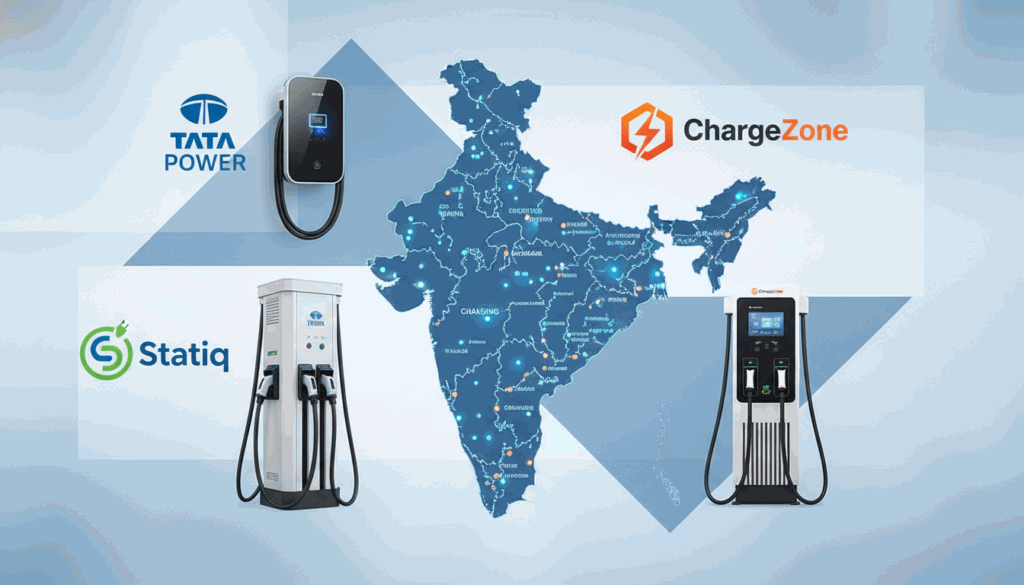
The Indian market features a mix of established energy conglomerates and agile startups offering robust EV charging franchise opportunities. Selecting the right brand requires evaluating their market presence, charger reliability, and the efficiency of their mobile application. Tata Power EZ Charge is currently one of the largest networks in India, known for its extensive reach and brand trust. They offer comprehensive support, though their approval process and space requirements can be stringent. Startups like Statiq and ChargeZone have gained massive popularity by offering highly flexible franchise models, aggressive revenue sharing, and state-of-the-art software backends. Zeon Charging dominates the southern corridors with highly reliable highway fast charging. When analyzing the EV charging franchise cost in India across these brands, it is important to look at the ‘Total Cost of Ownership’ rather than just the initial franchise fee. A brand that charges a slightly higher premium but provides excellent 24/7 technical maintenance and has a massive user base on its app will ultimately yield a faster ROI than a cheaper, lesser-known alternative.
Top EV Franchise Brands and General Requirements
| Brand Name | Space Requirement (Sq. Ft.) | Estimated Total Investment |
|---|---|---|
| Tata Power EZ Charge | 500 – 1000 | ₹15 Lakhs – ₹40 Lakhs |
| Statiq | 300 – 800 | ₹10 Lakhs – ₹30 Lakhs |
| ChargeZone | 600 – 1200 | ₹25 Lakhs – ₹50 Lakhs |
| Zeon Charging | 500 – 1000 | ₹20 Lakhs – ₹45 Lakhs |
| Volttic | 200 – 500 | ₹8 Lakhs – ₹20 Lakhs |
| Fortum Charge & Drive | 800 – 1500 | ₹30 Lakhs – ₹60 Lakhs |
Evaluating Franchise Support Systems
A good franchise partner should provide a turnkey solution. This includes site feasibility studies, load sanction assistance from the local electricity board, hardware installation, and full integration with their Central Management System (CMS). Post-installation support is even more critical; downtime at a charging station leads to immediate revenue loss and reputational damage.
The Importance of App Interoperability
As the market matures, EV drivers are resisting the need to download 20 different apps for 20 different brands. Franchise brands that have roaming agreements or integrate with aggregator apps (like EV Plugs or ElectreeFi) ensure your station is visible to a much larger audience, increasing your station’s daily utilization rate.
Industry Alert
Software Revenue Sharing
Most franchise networks charge a monthly CMS (Central Management System) fee or take a percentage of every transaction (usually 10% to 20%). Always clarify the software revenue-sharing structure before signing the franchise agreement.
Analyzing the Profitability and ROI of Your EV Franchise
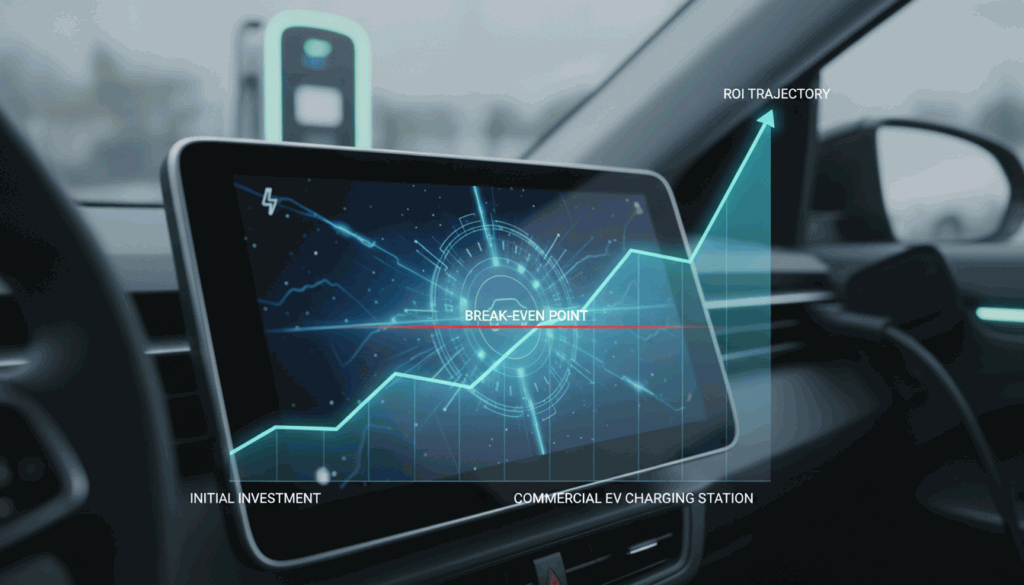
Ultimately, the decision to invest hinges on profitability. Once you have navigated the EV charging franchise cost in India, understanding your revenue streams is crucial. The primary source of income is the margin on the electricity sold. You purchase electricity at commercial or specialized EV tariffs set by the state government (typically ranging from ₹5 to ₹8 per kWh) and sell it to the consumer at a premium (usually ₹15 to ₹25 per kWh, depending on charging speed and location). After deducting the cost of electricity, franchise royalties, land rent, and maintenance, the net margin per kWh dictates your payback period. The most critical metric for an EV charging station is its ‘Utilization Rate’—the percentage of time your chargers are actively dispensing power. A station on a busy highway connecting two major cities might achieve a 30% utilization rate within a year, while a poorly placed city charger might struggle at 5%. Other revenue streams include advertising on digital screens attached to the chargers, parking fees, and supplementary businesses like a cafe or convenience store on the premises.
Projected Monthly Profitability Scenario
| Metric / Parameter | Scenario A (Low Utilization) | Scenario B (High Utilization) |
|---|---|---|
| Daily Vehicles Charged | 15 Vehicles | 45 Vehicles |
| Avg. Energy Dispensed per Vehicle | 20 kWh | 25 kWh |
| Total Daily Energy Sold | 300 kWh | 1,125 kWh |
| Net Profit Margin per kWh | ₹3.00 | ₹4.50 |
| Estimated Gross Monthly Revenue | ₹27,000 | ₹1,51,875 |
| Monthly Opex (Internet, Staff, Maint.) | ₹10,000 | ₹25,000 |
Calculating the Break-Even Point
A well-located commercial DC fast-charging station in India typically sees a break-even point between 2.5 to 4 years. This timeframe is heavily dependent on the initial capital expenditure and the local adoption rate of electric vehicles. As EV sales compound annually, utilization rates at strategically placed stations are expected to soar, drastically reducing the ROI timeline.
Government Policies Impacting Profitability
To promote EV infrastructure, the Ministry of Power has allowed the sale of electricity as a service without requiring a power distribution license. Furthermore, many state governments offer a subsidized ‘EV Tariff’ which is significantly lower than standard commercial rates, widening the profit margin for station owners.
R O I Benchmark
Supplementary Income is Key
Stations that offer amenities—such as Wi-Fi, clean restrooms, and a coffee shop—experience 40% higher customer retention. EV drivers are captive audiences for 30 to 60 minutes, making adjacent retail highly profitable.
Conclusion
In conclusion, determining the precise EV charging franchise cost in India depends heavily on your location, the capacity of the chargers you wish to install, and the specific franchise model you choose to adopt. While the initial capital requirement—ranging from ₹10 Lakhs to upward of ₹40 Lakhs for a comprehensive DC fast-charging hub—might seem substantial, the long-term prospects are undeniably promising. India is standing at the precipice of an electric mobility revolution. By investing in a franchise today, you are not just securing a first-mover advantage in a high-growth sector, but you are also contributing to a greener, more sustainable future. Conduct thorough market research, negotiate software revenue-sharing terms carefully, select a location with high EV traffic potential, and your EV charging franchise could become a highly lucrative, future-proof business asset.
Frequently Asked Questions
What is the minimum EV charging franchise cost in India?
The minimum cost to start an EV charging franchise in India typically ranges from ₹2 Lakhs to ₹5 Lakhs. This budget generally covers basic AC slow chargers suitable for two and three-wheelers in commercial or residential parking spaces.
Do I need a special license to start an EV charging station in India?
No, the Ministry of Power has de-licensed the setting up of public EV charging stations. You do not need a specific electricity distribution license, but you must comply with the technical and safety standards set by the Central Electricity Authority (CEA).
Is an EV charging franchise profitable in India?
Yes, it can be highly profitable depending on the location and utilization rate. With the rapid increase in EV adoption, well-placed stations on highways or urban hubs report healthy profit margins on the electricity sold, usually breaking even within 3 to 4 years.
How much space is required for an EV charging station?
A standard fast-charging station requires anywhere from 300 to 1000 square feet. This accommodates the physical chargers, dedicated parking slots for the vehicles being charged, safety bollards, and the electrical transformer.
Which are the top EV charging franchise brands in India?
Some of the leading brands offering franchise opportunities in India include Tata Power EZ Charge, Statiq, ChargeZone, Zeon Charging, and Fortum Charge & Drive.