
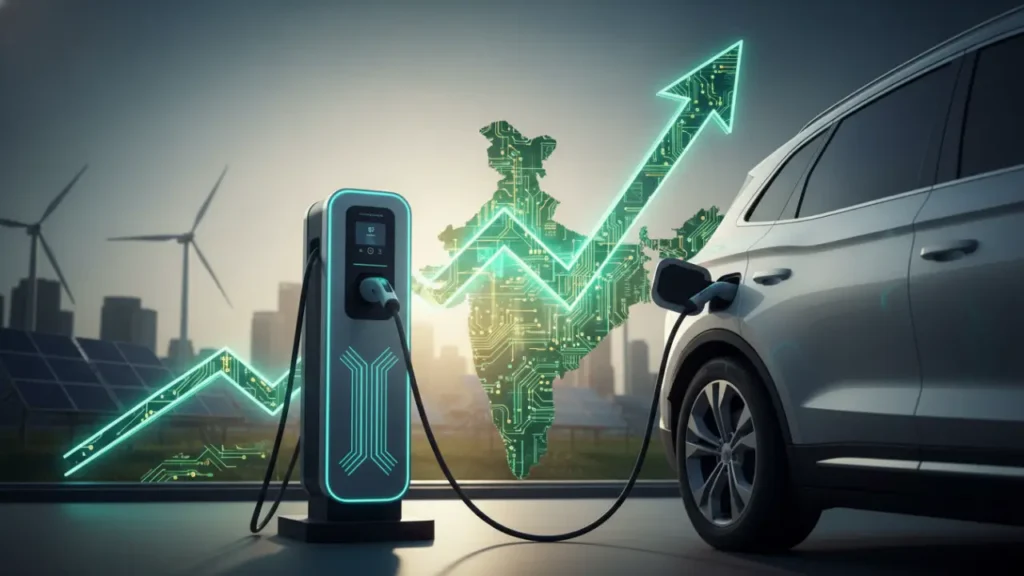
The electric vehicle (EV) revolution in India is no longer a distant dream; it is happening right now on our streets. With major automakers rolling out new electric cars, scooters, and commercial vehicles, the Indian roads are rapidly transforming. However, this massive shift towards electric mobility has created a critical gap that needs immediate filling: a robust EV charging infrastructure.
For entrepreneurs and investors, this gap represents one of the most lucrative business opportunities of the decade. If you have been wondering how to capitalize on the green energy boom, starting an EV charging franchise in India could be your golden ticket.
In this comprehensive guide, we will walk you through everything you need to know about starting an EV charging franchise in India, including the setup process, associated costs, potential profit margins, and the best business strategies to ensure your success.
Quick Summary
Alt Text: A modern EV charging station in an Indian city with an electric car plugged in
- Why Start an EV Charging Franchise in India?
- Exponential Growth of EVs
- Favorable Government Policies and Subsidies
- Low Competition and First-Mover Advantage
- Types of EV Charging Stations (Business Models)
- 1. AC Charging (Destination Charging)
- 2. DC Fast Charging (Highway/Commercial Charging)
- 3. Battery Swapping Stations
- Step-by-Step Guide to Setup an EV Charging Franchise
- Step 1: Market Research and Location Hunting
- Step 2: Choose the Right Franchise Partner
- Step 3: Legalities, Licenses, and Power Connections
- Step 4: Infrastructure Setup and Installation
- Cost to Start an EV Charging Franchise in India
- 1. Land and Lease Costs
- 2. Equipment and Hardware Costs
- 3. Grid Connection and Electricity Infrastructure
- 4. Civil Work and Branding
- 5. Franchise Fees and Software Integration
- Profit Margin and Return on Investment (ROI)
- Understanding the Revenue Model
- A Hypothetical Profit Scenario
- Challenges to Consider
- Grid Stability and Load Limits
- High Initial Capital Requirement
- Conclusion
Why Start an EV Charging Franchise in India?
Before diving into the numbers and setup procedures, it is essential to understand why the EV charging business is a highly viable venture in today’s Indian market.
Exponential Growth of EVs
India’s EV market is experiencing exponential growth, driven predominantly by two-wheelers and three-wheelers, with four-wheelers rapidly catching up. According to government data, EV sales in India have crossed the one-million mark annually and continue to climb. But here is the catch: while consumers are eager to buy EVs, “range anxiety” (the fear of running out of battery before reaching a destination) remains their biggest hurdle. Setting up charging stations directly solves this consumer pain point.
Favorable Government Policies and Subsidies
The Government of India is aggressively pushing for electric mobility. Through initiatives like the PM E-DRIVE scheme (the successor to FAME II) and state-specific EV policies in Delhi, Maharashtra, Gujarat, and Karnataka, the government is offering subsidies for setting up charging infrastructure. Furthermore, the Ministry of Power has delicensed the setting up of public charging stations (PCS), meaning any individual can set up a station without needing a specific license, provided they meet technical and safety standards.
Low Competition and First-Mover Advantage
While petrol pumps are saturated in almost every corner of the country, EV charging stations are still sparse, especially on highways and in Tier-2 and Tier-3 cities. By entering the market now, you can secure prime locations, build brand loyalty, and establish a monopoly in your local area before heavy competition arrives.
Types of EV Charging Stations (Business Models)
When starting your franchise, you will need to decide what kind of charging infrastructure you want to offer. The technology and target audience dictate your costs and revenue.
1. AC Charging (Destination Charging)
AC (Alternating Current) chargers are slow chargers typically used where vehicles are parked for longer durations, such as shopping malls, multiplexes, hotels, office parking lots, and residential complexes.
- Charging Time: 4 to 8 hours.
- Cost: Very low capital investment.
- Target: Two-wheelers, three-wheelers, and hybrid/commuter cars.
2. DC Fast Charging (Highway/Commercial Charging)
DC (Direct Current) chargers bypass the car’s onboard charger to deliver power directly to the battery, making them incredibly fast. These are essential for highways, dedicated EV hubs, and commercial fleet operators.
- Charging Time: 45 minutes to 1.5 hours (up to 80% charge).
- Cost: High capital investment.
- Target: Long-distance travelers, cab fleets, luxury EVs, and heavy commercial vehicles.
3. Battery Swapping Stations
Instead of charging a depleted battery, users simply swap it for a fully charged one. This model is currently highly popular for electric two-wheelers and e-rickshaws in India, pioneered by companies like Sun Mobility and Gogoro.
Step-by-Step Guide to Setup an EV Charging Franchise
Starting an EV charging franchise requires careful planning and execution. Here is a simplified roadmap to get your station up and running.
Step 1: Market Research and Location Hunting
The success of an EV charging station relies heavily on its location. An obscure location will result in zero footfall. You need a site with high visibility and accessibility.
- Ideal Locations: National and state highways, petrol pumps, shopping malls, IT parks, large residential societies, and popular restaurants/dhabas.
- Space Required: At least 100 to 200 sq. ft. per vehicle, plus space for the actual hardware and transformer.
Pro Tip
Partner with existing commercial establishments. If you set up a charging station at a popular highway restaurant, EV owners will naturally spend 45-60 minutes there eating while their car charges. It’s a win-win for both your charging business and the restaurant!
Step 2: Choose the Right Franchise Partner
Several established companies in India offer franchise models. Partnering with a recognized brand saves you from the hassle of building an app, sourcing chargers, and marketing. Top EV charging networks operating in India include:
- Tata Power EZ Charge
- ChargeZone
- Zeon Charging
- Statiq
- Volttic When selecting a franchisor, evaluate their franchise fee, revenue-sharing model, software reliability, and the after-sales maintenance support they provide.
Step 3: Legalities, Licenses, and Power Connections
While you don’t need a specific “license” from the government to start, you do need regulatory clearances:
- Company Registration: Register your business as a Proprietorship, LLP, or Pvt Ltd.
- GST Registration: Mandatory for billing and taxation.
- DISCOM Approval: You must apply to your local electricity board (DISCOM) for a separate commercial EV charging connection. The government has mandated special, subsidized EV tariffs for these meters, which are lower than standard commercial rates.
- NOCs: Fire safety NOC and local municipal clearances may be required depending on your state.
Step 4: Infrastructure Setup and Installation
Once approvals are in place, your franchise partner will usually handle the procurement and installation of the equipment. This includes:
- Civil work (leveling the ground, creating parking bays).
- Electrical work (laying high-tension cables, installing transformers or distribution boards).
- Erecting the canopy and branding signages.
- Installing the Central Management System (CMS) software and linking it to the consumer mobile app.
Alt Text: An entrepreneur inspecting an EV charging station installation setup in an open parking lot
Cost to Start an EV Charging Franchise in India
The investment required varies drastically based on the capacity and type of chargers (AC vs. DC), the location, and the specific franchise model. Below is a detailed breakdown of the expected costs for a standard DC Fast Charging Station setup (capable of charging two cars simultaneously).
1. Land and Lease Costs
If you already own commercial land, this cost is zero. If you are leasing, highway locations might cost you between ₹15,000 to ₹50,000 per month, depending on the state and exact highway.
2. Equipment and Hardware Costs
This is where the bulk of your investment will go.
- AC Chargers (Bharat AC 001 or Type 2): ₹50,000 to ₹1.5 Lakhs per unit.
- DC Fast Chargers (CCS2 – 30kW to 60kW): ₹8 Lakhs to ₹15 Lakhs per unit.
- Ultra-Fast DC Chargers (120kW+): ₹20 Lakhs to ₹35 Lakhs+.
3. Grid Connection and Electricity Infrastructure
To power DC fast chargers, a standard electrical connection is insufficient. You will likely need to upgrade your load and install a dedicated transformer.
- Transformer and Cabling: ₹3 Lakhs to ₹8 Lakhs.
- New Meter Deposit: ₹50,000 to ₹1 Lakh.
4. Civil Work and Branding
Preparing the site, painting the bays, erecting protective bollards, creating a canopy, and putting up LED signboards.
- Estimated Cost: ₹1.5 Lakhs to ₹3 Lakhs.
5. Franchise Fees and Software Integration
Most franchisors charge an onboarding fee and require you to use their white-labeled software to track usage, bill customers, and monitor charger health.
- Estimated Cost: ₹1 Lakh to ₹3 Lakhs (one-time).
Important Facts
**Total Estimated Investment:** If you are setting up a basic **AC charging destination**, you can start with an investment as low as **₹2 Lakhs to ₹5 Lakhs**. If you want to set up a competitive, high-speed **DC Fast Charging Station** on a highway, be prepared for a capital expenditure of **₹15 Lakhs to ₹30 Lakhs**, excluding land costs.
Profit Margin and Return on Investment (ROI)
The profit in the EV charging business is made on the margin between the cost of electricity purchased from the state electricity board and the price at which you sell it to the EV owner.
Understanding the Revenue Model
- Cost of Electricity: Thanks to government policies, the EV charging tariff from the DISCOM generally ranges from ₹5.50 to ₹8.00 per kWh (unit), depending on the state.
- Selling Price: As a charging station owner, you can sell this electricity to consumers at ₹15 to ₹22 per kWh for DC fast charging (and around ₹10 to ₹15 for AC charging).
- Gross Margin: This gives you a gross margin of roughly ₹8 to ₹14 per unit (kWh) sold.
A Hypothetical Profit Scenario
Let’s assume you have a 60kW DC Fast Charger running at a moderate utilization rate.
- Average units sold per vehicle: 30 kWh
- Cars charged per day: 15 cars
- Total units sold per day: 450 kWh
- Your Gross Margin per unit: ₹10
- Daily Gross Profit: ₹4,500
- Monthly Gross Profit: ₹1,35,000
From this gross profit, you must deduct operational expenses (OPEX):
- Land Rent: ₹30,000
- Maintenance / Internet / Software fee (often a 10-15% revenue share with the franchisor): ₹15,000
- Staff/Security (optional): ₹15,000
Estimated Net Profit: ₹75,000 per month (₹9 Lakhs annually).
With a capital investment of ₹20 Lakhs, an annual return of ₹9 Lakhs translates to a highly attractive payback period of just over 2 to 2.5 years. As EV adoption increases, the utilization rate of your station will rise, pushing profits even higher.
Alt Text: Infographic showing the profit breakdown of an EV charging station business in India, comparing input electricity costs vs selling price
Challenges to Consider
While the numbers look incredibly promising, no business is without its hurdles. Being aware of these challenges will help you navigate them effectively.
Grid Stability and Load Limits
In India, consistent power supply can still be an issue in remote areas. A fast-charging station requires high, uninterrupted voltage. Frequent power cuts will lead to poor customer experience. Additionally, obtaining high-load sanctions (like 100kW or 200kW) from local DISCOMs can sometimes be mired in bureaucratic delays.
High Initial Capital Requirement
Unlike a small retail store, setting up a DC fast-charging station requires substantial upfront cash. While the ROI is good, blocking ₹20 to ₹30 Lakhs in hardware requires serious financial commitment. Furthermore, EV technology is evolving rapidly; a 30kW charger considered “fast” today might become obsolete as new cars demand 150kW+ chargers.
Common Mistakes
**Ignoring Future Expansion:** Many new franchise owners buy exactly the amount of land and transformer capacity they need for one charger. When demand increases, they lack the electrical load and physical space to add more chargers. Always plan your grid connection and space with future scalability in mind!
Conclusion
Starting an EV charging franchise in India is a forward-thinking business venture that aligns perfectly with the global shift towards sustainability. With the Indian government rolling out red carpets for EV infrastructure developers, and consumers eagerly embracing electric mobility, the timing could not be better.
While the initial setup cost—particularly for DC fast chargers—can be high, the recurring revenue model, low manpower requirements, and excellent profit margins make it a highly rewarding long-term investment. By conducting thorough location research, partnering with a reliable franchisor, and focusing on customer convenience, you can build a highly profitable green business.
Take the leap, contribute to a cleaner environment, and power the future of Indian transportation! If you are ready to start, begin by reaching out to local electricity boards for tariff details and contacting top EV franchisors to compare their offerings.